


A first Caribbean cruise comes down to four choices, and only one of them is the cruise line. Which stretch of the Caribbean, which month, how big a ship, and where you sail from. Get those right and almost any decent line will give you a good week. I’m Donnetta Byrd, a travel advisor in San Antonio, Texas. I have sailed the Caribbean a number of times myself, including on some of the largest ships afloat, which is part of why I steer so many people toward the smaller ones. Here is how I work through it with people who have never done this before.
Eastern, Western, Southern, and what the labels actually mean
These are marketing regions, not geography, and the lines do not fully agree on where the boundaries sit. St. Lucia and Dominica get filed differently depending on who is writing the brochure. So read the port list, not the region name.
What the labels really tell you is how far the ship has to travel, which decides how much of your week is at sea.
Eastern is St. Thomas, St. Maarten, Puerto Rico, Tortola, Grand Turk, Antigua, St. Kitts. Seven nights is standard out of Florida. It is the shopping-and-island-hopping version, and it is the busiest. St. Thomas and St. Maarten can see more than ten thousand cruise passengers in a day.
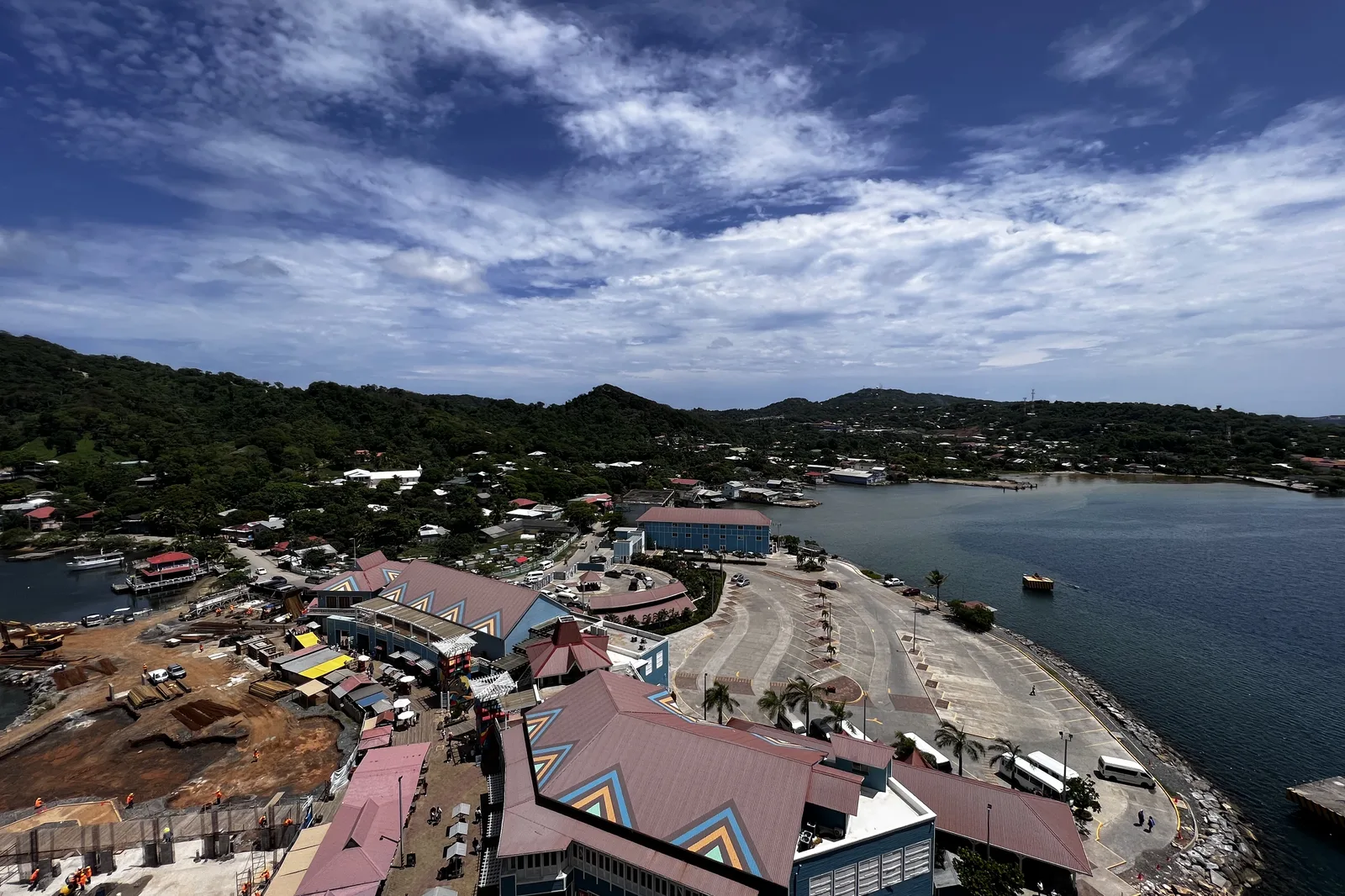
Western is Cozumel, Grand Cayman, Jamaica, Roatán, Belize, Costa Maya, Key West. Ruins, reefs and rainforest. It is usually the cheapest way in, and it is what almost everything sailing from Texas and New Orleans does.
Southern is the ABC islands, Barbados, St. Lucia, Grenada, Dominica, Martinique. Longer, typically seven to ten nights or more, and much less crowded. It is also the prettiest from the deck, which is why it is the one I steer most of my clients toward. Willemstad’s painted waterfront, the volcanic peaks coming up out of the water in St. Lucia, the drive down into Roseau. If you are the sort of traveler who wants to look at the water rather than lie down next to it, Southern is your answer.
The month matters more than the line
Hurricane season officially runs June 1 through November 30, and the statistical peak is around September 10, with the busiest stretch from mid-August to mid-October. That is not my opinion, it is the National Hurricane Center.
Here is the part people get wrong. The risk of a hurricane-season sailing is almost never danger. Ships move, and they do not sail into storms. The risk is that your itinerary gets rewritten. If you booked the cruise because you wanted to see Curaçao, and the ship spends that day somewhere else instead, the trip you bought is not the trip you took.
September and October are the two cheapest months of the year, running a couple of hundred dollars a person below December. For a couple that is around five hundred dollars on a five thousand dollar trip. My question back is always the same. Is ten percent worth ports you cannot count on?
For a first cruise I point people at late January through April, skipping the spring break weeks, or the first two weeks of December. Dry season, no hurricane exposure, and well below the holiday and midsummer peaks. If you want warm water specifically, note that in deep winter the Bahamas sit around 72 degrees while the ABC islands are closer to 79, which is one more argument for going further south.
How big a ship, and the hard trade you have to make
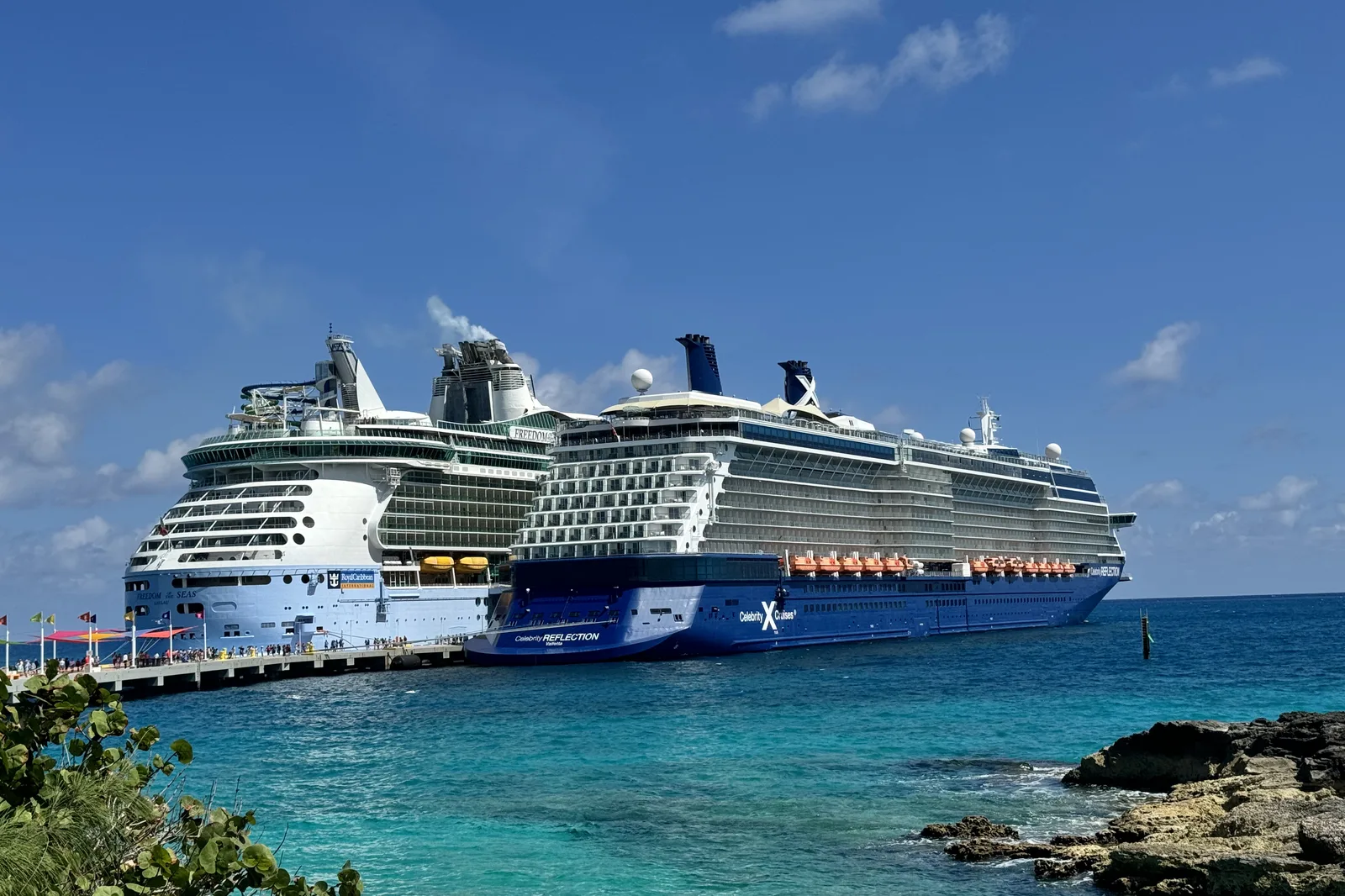
The range out there is enormous and nobody tells first-timers this. Viking Ocean’s ships carry under a thousand guests. Royal Caribbean’s Icon of the Seas carries 5,610 at double occupancy. That is roughly six times the people on the same sea.
I lean smaller almost every time, because the whole point of the Caribbean is what is outside the ship, and a smaller ship gets you ashore faster and into ports the big ones cannot enter. The smaller options worth knowing by name are Viking’s ocean ships at around 930, Holland America’s Volendam at 1,432, Princess’s Island Princess at around 2,000 to 2,200, and Royal Caribbean’s Vision of the Seas at about 2,050, which moves to San Juan in October 2027 for Southern Caribbean weeks. Coral Princess is the same size and a good ship, but she is away on a world cruise from January to April 2028, so that year she is a fall option rather than a winter one. Deployments like that are exactly what puts people on the wrong week, which is why I check the schedule rather than the brochure.
A bigger ship is not a mistake. It is more dining, more entertainment, usually a lower fare, and if you are bringing grandchildren it is the right call. Just make it a choice rather than an accident.
Where you sail from, and the Galveston problem
If you live in south Texas, Galveston is the obvious answer. It is a drive rather than a flight, which takes airfare for two out of the budget and takes away the single most common regret I hear from cruisers, which is flying in on the morning the ship leaves. Do not do that. Ever. The ship does not wait.
I still put you in a hotel the night before, even though you drove. It is a four hour drive from San Antonio and things go wrong on I-10. A night in Galveston means you arrive rested, you are not watching the clock, and a blown tire on embarkation morning is an inconvenience instead of a missed ship. It is the cheapest insurance on the whole trip.
Now the part your Galveston research will not tell you. Texas is a big-ship port, with two seasonal exceptions. The 2027 and 2028 lineup runs to Royal Caribbean’s Icon of the Seas at 5,610 guests and Liberty of the Seas at 3,798, Norwegian Escape for the winter and Norwegian Prima the summer after, and a wall of Carnival.
The exceptions are worth knowing because they are the only way to get a small ship without an airport. Disney Magic, at about 1,750 guests, is based in Galveston for the 2027 to 2028 winter. Carnival Miracle, at 2,100, runs a short spring 2027 season from there before crossing to Lisbon. Outside those two windows, if you want a small ship and no flight, you cannot have both, and I would rather say that now than let you discover it after you have fallen for a ship.
Galveston is also Western Caribbean, and because the ship has to cross the Gulf first, a week from Texas typically buys you three ports where the same week from Miami buys four.
One more Galveston gap worth knowing, since Princess is a line I book a lot. Princess left Galveston after the 2025 to 2026 season and has nothing on the schedule to bring it back. If you specifically want Princess, you are flying to Florida or San Juan.
The other homeports worth knowing. Fort Lauderdale is Holland America’s Caribbean base and a major Princess one too, with Princess also using Port Canaveral, Miami, New York and San Juan. Tampa is the small-ship port, because the Sunshine Skyway Bridge caps ship height and forces the lines to send smaller vessels. And San Juan is the one that changes the math entirely, because sailing from there puts you in the Southern Caribbean with barely any sea days at all. The catch from San Antonio is that there is no nonstop, so budget a connection and a night on the front end.
How long, and why not a long weekend
Book seven nights. Not three, not four.
Short cruises look like a sensible way to try it, and they are the most reliable way to decide you do not like cruising. It takes a day or two to settle into the rhythm. Short sailings give you almost no sea days, so you never actually experience the ship. They call at the busiest ports, so your one impression of the Caribbean is Nassau with twenty-five thousand other people in it. And the nightly rate is higher, not lower.
Five to eight nights is the range. Seven is the sweet spot.
The four things first timers spend money on and regret
A guaranteed cabin. You save a little and the line puts you wherever it likes, often under the pool deck or next to a service door. For a first cruise, pick your cabin. Midship, low to middle deck, is the least motion.
An obstructed balcony. If you are paying for a balcony because of the view, check that a lifeboat is not parked in it.
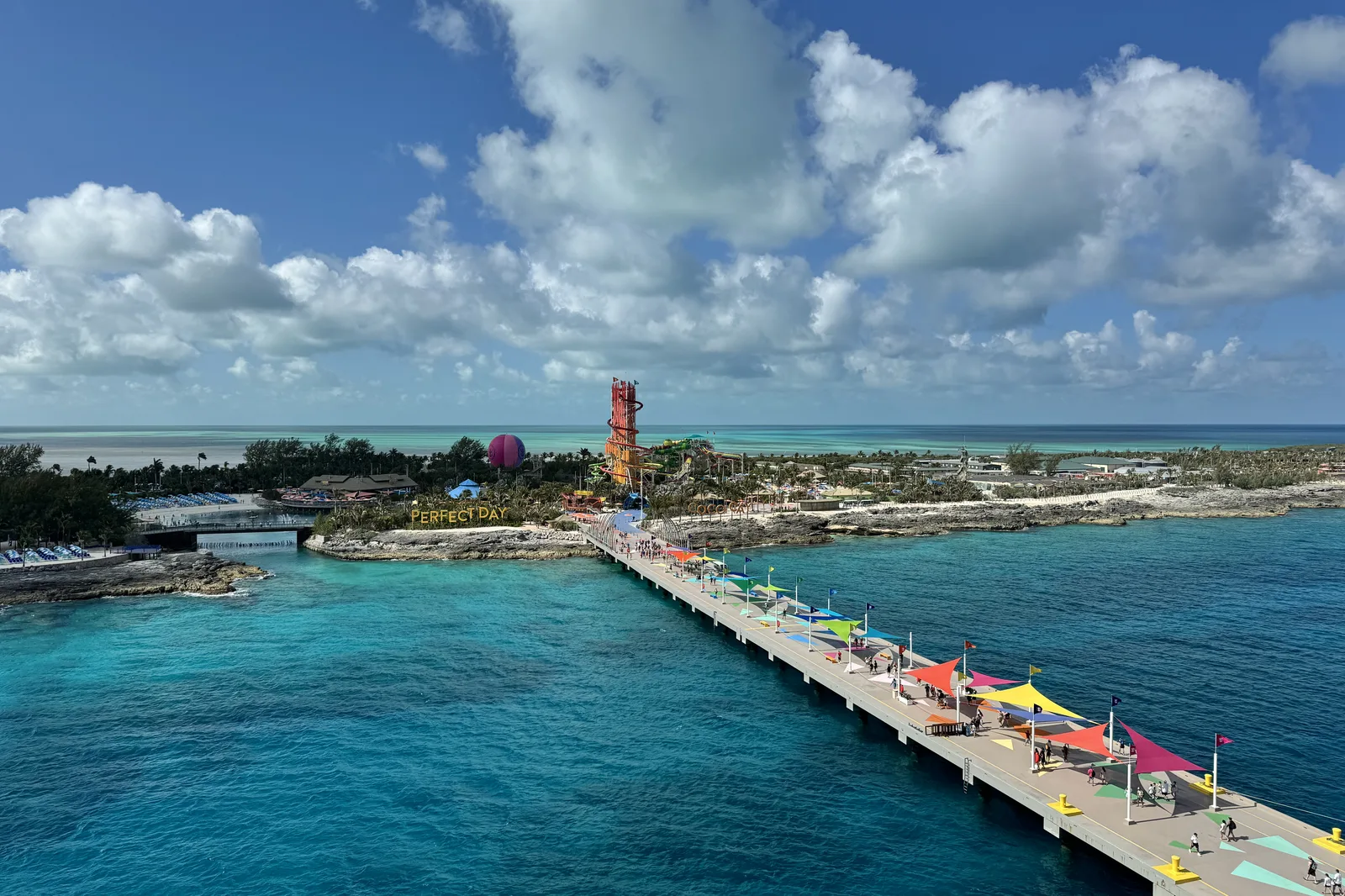
The private island upsell. Most of the private destinations already include the beach, the loungers and lunch. The paid add-ons run steep. A pair of beach club passes at Royal Caribbean’s CocoCay can run north of four hundred dollars for one afternoon, on a day where the free beach was already good. Skip it and put the money into a shore excursion somewhere you actually want to be.
A full-day tour in every port. You will be exhausted by Thursday. Book the guided tour in the two or three places where a guide adds something and walk the town in the rest. Read the activity level on every excursion listing before you book, not after.
One thing worth knowing about private islands generally. Half of them are not islands. Princess Cays is a leased 40-acre beach on Eleuthera and needs tendering. Holland America’s Half Moon Cay really is an island, and it is being rebuilt and renamed RelaxAway with a pier so ships can dock instead of tender, which is a real improvement if you have any trouble with steps into a small boat.
What I would book for a first timer
If you want the easiest possible first cruise and you are in Texas, seven nights out of Galveston in February or March on the newest ship you can afford. You will have a good time and you will not have flown.
If you want the better trip and you are willing to fly, seven to eleven nights in the Southern Caribbean, ideally from San Juan, on the smallest ship that fits your budget. More ports, fewer sea days, better scenery, far fewer crowds.
If what you actually want is to be looked after and to have the touring handled, Viking, and understand that the fare is the trip rather than the starting point.
First Caribbean cruise FAQ
Which Caribbean is best for a first cruise? Western if you are sailing from Texas and want it simple. Southern if you care about scenery and smaller crowds and can fly. Eastern if you want the classic island-hopping week and do not mind busy ports.
When is the best time to cruise the Caribbean? Late January through April, avoiding spring break, or the first two weeks of December. Those give you dry season weather without hurricane exposure or holiday pricing.
Is it safe to cruise during hurricane season? Yes, in the sense that ships avoid storms. The real cost is that your ports can change with little notice. If you have your heart set on specific islands, sail outside August through October.
How long should my first cruise be? Seven nights. Short sailings do not give you enough time to settle in, and they visit the most crowded ports.
Can I drive to my cruise from San Antonio? Galveston is a drive, which is a real advantage. The trade-offs are that Galveston sails Western Caribbean, mostly on large ships, and that you get one fewer port than the same week from Florida because the ship crosses the Gulf first.
Do I need a passport? Get one, with at least six months of validity beyond your travel dates. There are narrower rules for some closed-loop sailings, but a passport removes every complication if something goes wrong and you need to fly home from a port.
Let’s pick your first one
Tell me when you can travel, whether you would rather drive or fly, and how many people you want on your ship, and I can narrow the whole Caribbean down to two or three sailings that fit. I will give you the real all-in number including the extras, and I will tell you which upsells to skip. If you are still deciding whether you need an advisor at all, I wrote about that separately. Otherwise, reach out and tell me what you are picturing.