

Canyon Spirit is a daylight-only glass-dome train that runs between Denver, Moab and Salt Lake City, with hotel nights in between. It comes from the same company behind Rocky Mountaineer, and most of my clients have never heard of it. I’m Donnetta Byrd, a travel advisor who specializes in train travel, and I have ridden this train twice. Here is what it actually is, what it costs, and who I would and would not put on it.
Where the name came from
If you have been shopping American train trips for a couple of years, you may know this train as Rockies to the Red Rocks. That was Rocky Mountaineer’s U.S. service, launched in 2021. The company rebranded the U.S. side as Canyon Spirit, announced in 2025 and effective with the 2026 season.
Two things people get confused about. First, Rockies to the Red Rocks did not go away, it is still the route name underneath the Canyon Spirit brand, so you will see both. Second, the Rocky Mountaineer connection is real and the company says so itself, describing Canyon Spirit as part of the same group. If you rode Rocky Mountaineer in Canada and loved it, this is the same operation applied to the American Southwest. If you want my take on Rocky Mountaineer first, I wrote that separately.
The routes
There are two, and they are the same track in different lengths.
Two days, Denver to Moab. Depart Denver Union Station in the morning, ride to Glenwood Springs, overnight there, then ride Glenwood Springs to Moab the next day. It runs in both directions.
Three days, Denver to Salt Lake City. The two-day trip plus a third day on the train between Moab and Salt Lake City. Two overnights, in Glenwood Springs and Moab. The Salt Lake City segment is the newest piece, added for the 2026 season.
The season runs April through November, which is a longer window than the Canadian trains get.
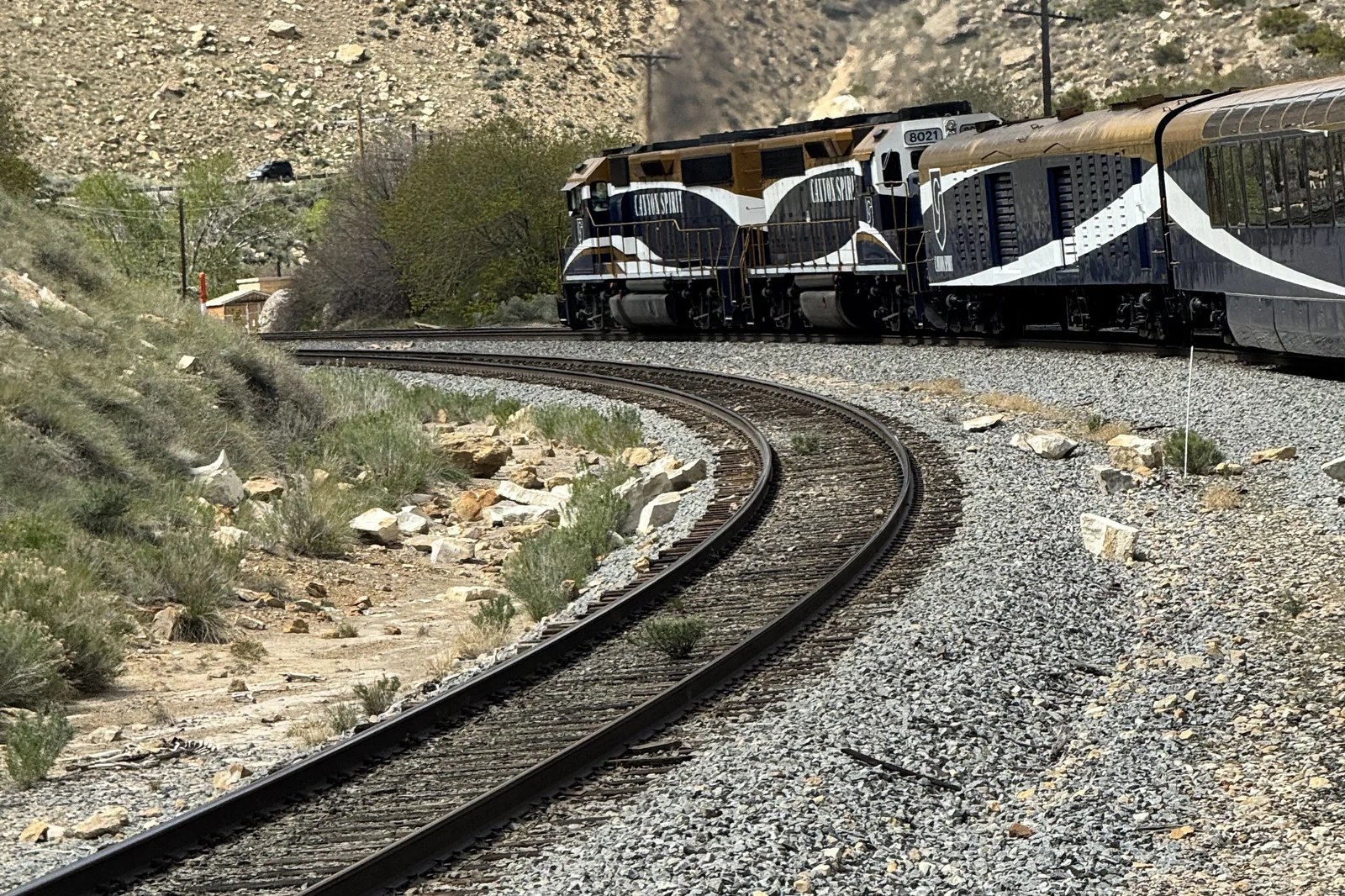
One detail worth knowing before you book. The train does not pull into downtown Moab. It uses a siding several miles outside town, and there is a second Moab-area railhead at Thompson Springs. Transfers are handled, but do not picture stepping off onto a Main Street platform.
Daylight only, and why that matters
There are no sleeper cars. You ride during the day, roughly five and a half to nine and a half hours depending on the segment, and you sleep in a hotel. The company’s whole argument is that you should not sleep through the scenery, and having sold plenty of overnight trains, I think they are right about this route.
The practical effect is that this is a comfortable trip for people who do not love the idea of a train berth. You get a real hotel bed every night, your luggage is moved for you, and you are not negotiating a ladder at 70.
Signature and Premier, not GoldLeaf and SilverLeaf
If you know the Canadian product, reset your vocabulary. Canyon Spirit has its own two classes.
Signature is the included level. Custom single-level dome cars with oversized curved glass, pre-assigned reclining seats, access to an open-air viewing vestibule at the end of the car, meals cooked and served to your seat, a full drinks selection, snacks, and up to three hosts narrating the scenery, the wildlife and the history. Luggage goes ahead to the hotels.
Premier adds a lounge car with its own host and bar service, elevated meals with paired wines, signature cocktails, a second outdoor viewing area, an extra restroom, and more staff per guest.
Here is the difference from Canada that nobody explains well. The cars are single-level, not bi-level, because the tunnels on this route will not clear a two-story car. So there is no downstairs dining room and no bi-level dome. Meals come to your seat in both classes. If you are choosing between this and the Canadian train specifically because you want the GoldLeaf dining room downstairs, you will not find it here.
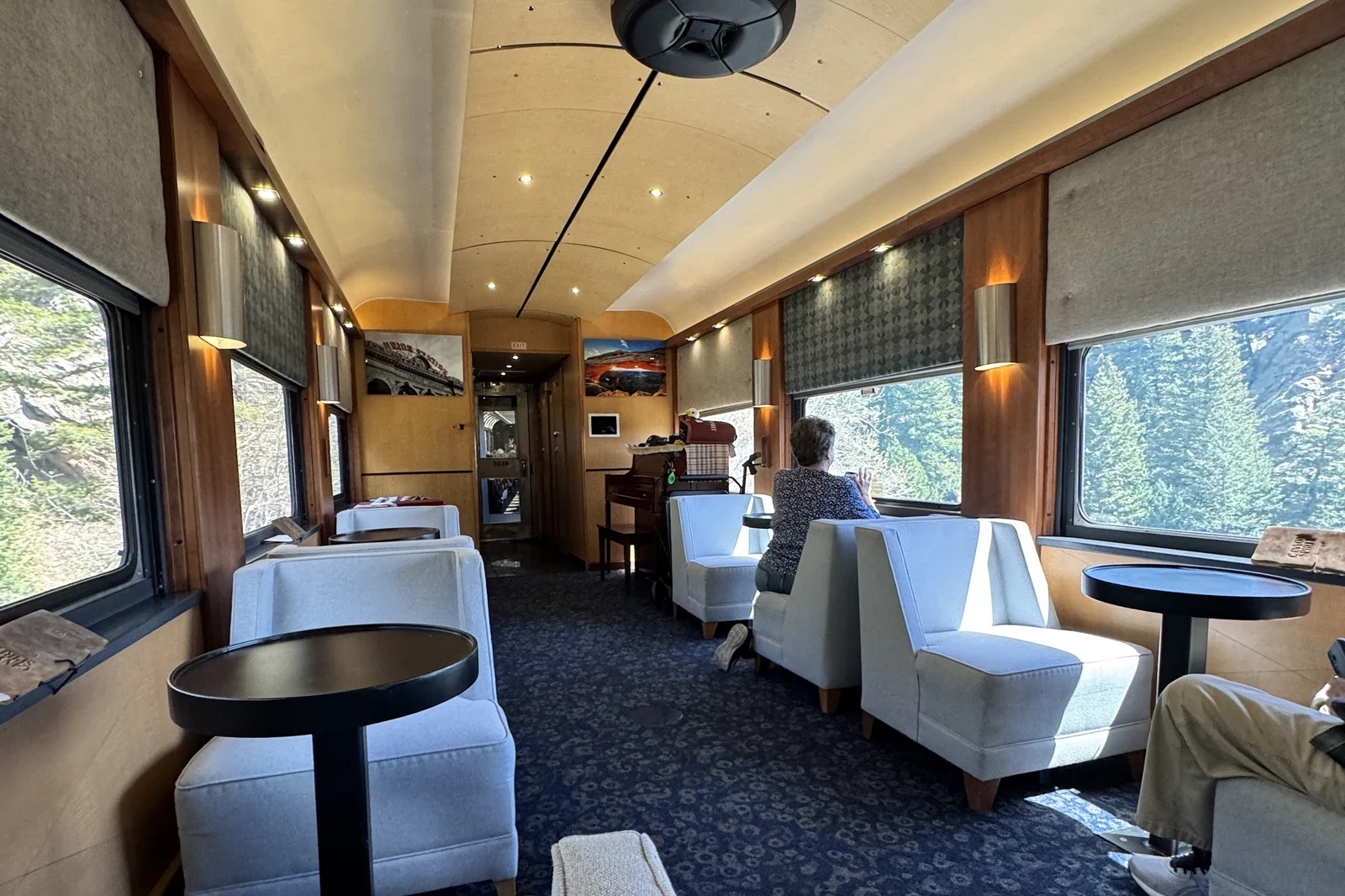
Onboard meals, snacks and drinks are included, and so are onboard gratuities. There is no wifi, and cell service disappears in stretches. I consider that a selling point, though I do warn people.
What you actually see
This is a spectacular route, and unlike a lot of scenic trains, a good share of it is only visible from the train.
Out of Denver you climb into the Front Range and go through the Moffat Tunnel, more than six miles under the Continental Divide at around 9,200 feet. Then Byers Canyon, then a long run beside the Colorado River, then Glenwood Canyon, a gorge the Colorado spent about three million years cutting.
Day two brings De Beque Canyon, Mount Garfield at the edge of the Book Cliffs, and the Book Cliffs themselves running nearly two hundred miles. The highlight is Ruby Canyon, twenty-five miles of red sandstone along the Colorado and Utah line that the operator says you can only reach by train or by water. That claim is the real heart of this trip.
The Salt Lake City day runs through Price Canyon and up toward the Wasatch.
A correction I make often. The train does not go into Arches or Canyonlands. Moab is the base for both, and you see them on land time, not from your seat.
What it costs
First thing to understand is what the base fare already covers. The rail fare includes your hotel nights along the route, so you are not pricing the train and then adding rooms on top. Per person, the two-day Denver to Moab trip runs roughly 1,800 dollars at the Signature level. The three-day Denver to Salt Lake City runs about 2,500 in Signature and a little over 3,000 in Premier.
Packages that add touring and extra nights start closer to the high two thousands and low three thousands than most people guess. It is the long national parks itineraries, the ones that pair the train with a motorcoach loop through Utah and end in Las Vegas, that get you into five and six thousand.
Here is the counterintuitive part, and it is worth real money. July and August are usually the cheapest months on this train, not the most expensive. On the three-day route the summer fare runs a few hundred dollars per person below the shoulder months. Compare a few dates rather than assuming peak summer costs the most. There are also standing discounts worth asking about, including one for U.S. military and one for returning Rocky Mountaineer guests.
Treat all of that as the shape rather than a quote. I price the specific date and class you want.
How it is sold, and the 2027 additions
The base fare is the train plus the hotel nights the route requires. From there you can add touring, extra nights in Moab or Glenwood Springs, and pre or post nights in Denver or Salt Lake City. The packaged versions run from about three nights up to a week, and the longest ones pair the train with a motorcoach loop through Utah’s national parks, ending in Las Vegas.
New for 2027 are two extended-stay packages, one adding time in Moab and one adding time in Glenwood Springs, both six days and five nights, both including Arches and Canyonlands touring as standard. Those are the ones I am most interested in for my clients, because the common complaint about the shorter versions is that Moab deserved another day.
Who this is right for
This suits the traveler who wants the scenery without the effort. If you want to see canyon country but you are past the point of wanting to drive it yourself, or hike into it, this hands you the views with a meal in front of you and someone telling you what you are looking at.
It works beautifully for a couple celebrating something, for two couples traveling together, and for anyone who liked the Canadian train and wants the American version. It pairs naturally with Denver pre-nights and with Arches and Canyonlands after.
It is not right for you if you want a lot of walking and hiking built in, if you need wifi for work, or if you want a sleeper-train experience. And if you want the full bi-level dome and downstairs dining car, that is the Canadian product, not this one.
Canyon Spirit FAQ
Is Canyon Spirit the same as Rocky Mountaineer? Same company, different brand. Canyon Spirit is the U.S. train, rebranded from Rockies to the Red Rocks starting with the 2026 season. Rocky Mountaineer continues under its own name in Canada.
How long is the trip? Two days on the train between Denver and Moab, or three between Denver and Salt Lake City. Packages with hotels and touring run from about three nights up to a week.
Are there sleeper cars? No. It is daylight only, with hotel nights in Glenwood Springs and Moab.
What is the difference between Signature and Premier? Signature gives you the dome car, meals at your seat, drinks, snacks and hosts. Premier adds a lounge car, upgraded meals with wine pairings, cocktails, a second outdoor viewing area and more staff. Both are single-level dome cars.
Does the train go through Arches National Park? No. Moab is the base for Arches and Canyonlands, and you visit them on land time as an excursion or as part of a package.
When does it run? April through November.
Is there wifi? No, and cell service drops out in places along the route.
Let’s build the trip
If Canyon Spirit sounds like your kind of train travel, the piece I add is the shape of the trip around it. Which direction to ride, whether the third day to Salt Lake City earns its cost for you, how many nights Moab actually deserves, and whether Signature or Premier is the better spend for how you travel. I will price it fully and hand you a bound itinerary with everything in it. Reach out and let’s build it.